
T-Shirt Relabelling in the UK: Printed and Sewn In Labels for Your Clothing Brand

Published
T-shirt relabelling is a process that replaces the manufacturer's label with your own, so blank garments can become your brand. Here is how printed and sewn in labels compare, what UK law says must be on a clothing label, and how we print, relabel and finish garments in one place.
Relabelled garments can be found everywhere, from independent clothing brands to high streets up and down the country. If you are looking to build a clothing brand or sell bulk printed garments, relabelling is the best way to turn quality blank garments into a range that carries your brand's name, rather than the manufacturer's.
At 1WorldPrint we print, relabel and finish garments for brands in London and across the whole of the UK. We remove the original label and replace it with a printed neck label or a sewn in woven label, and we can add hem tags, swing tags, folding, bagging (made from 90% recycled material) and barcode stickers, so your stock arrives all ready to sell.
Key points
- Relabelling replaces the manufacturer's label with your own printed neck label or sewn in woven label.
- Garment fibre composition must legally be on every garment sold in the UK, and it can stay on the care label inside the side seam. Care labels and country of origin are not legal requirements, but care instructions are expected and help avoid issues.
- We can add hem tags, swing tags, folding, bagging and barcode stickers so your range is ready to sell.
- Garments that come with tear-away labels, such as Alstyle, come out cleanly and make relabelling a quicker process.
- Screen printing starts at 20 units per design, and direct to garment, direct to film and embroidery start at 8 units.
In this guide
- What is t-shirt relabelling?
- Private label clothing and custom clothing labels
- Printed or sewn in labels: which is best?
- What must be on a clothing label in the UK?
- Is relabelling clothing legal?
- Adding sizes to relabelled garments
- Hem tags
- Swing tags
- Folding, bagging and barcodes
- The best garments for relabelling
- How relabelling works at 1WorldPrint
- Why brands choose 1WorldPrint
- T-Shirt Relabelling FAQs
What Is T-Shirt Relabelling?
T-shirt relabelling means taking a garment from a wholesale brand, removing its label and replacing it with your own branding. So instead of selling, for example, a Gildan t-shirt with the Gildan label in the neck, you sell the same t-shirt under your own brand name.
The original label is either cut out or cleanly removed. A lot of brands now even make garments with tear-away labels, which leave a very clean finish and take less time to remove than cutting. Every Alstyle garment has a tear-away label, and several AS Colour styles, including the 5082 Heavy Faded Tee, 5171 Box Hood and 5161 Relax Hood, have tear out labels.
Once the original label is out, it is replaced with either a label printed inside the neck or a label sewn into the neck seam. Both can carry your logo, the size, care instructions and fibre content. A printed neck label is now the most popular choice with our clients, rather than a sewn in label.
Private Label Clothing and Custom Clothing Labels
Private label clothing is when clothing is made by one company and sold under another company's brand. Relabelling is the simplest way to start a private label clothing range: you choose quality blank garments from brands such as AS Colour, Stanley/Stella or Earth Positive, and we replace the manufacturer's label with your own, then decorate the garments with your designs using your preferred printing method.
Your custom clothing labels can be printed inside the neck or sewn in as woven labels, carrying your logo, sizes, care instructions and garment composition. Add hem tags, swing tags, folding, bagging and barcode stickers, and your private label range arrives ready to sell online, in a shop or through one of our fulfilment centres.
Because direct to garment, direct to film and embroidery start at 8 units, you can test a new design in small numbers, then move your best sellers to screen printing at 20 units or more per design, where the cost per garment drops as quantities rise. Our guide to keeping t-shirt printing costs down explains how quantity and colours affect price.
Printed or Sewn In Labels: Which Is Best?
There is no single right answer, as it depends on the garment, the finish you want and personal preference. Here are the relabelling options at a glance.
| Option | Where it goes | What it does |
|---|---|---|
| Printed neck label | Inside the neck, where the original label was | Your brand, size and care details printed straight onto the garment for a tag free feel |
| Woven neck label | Sewn into the neck seam | A fabric label with your brand woven in, for a traditional retail finish |
| Hem tag | Folded into the sleeve or front hem | Puts your brand on the outside of the garment |
| Swing tag | Attached with a kimble | A printed tag for a retail ready finish |
Printed neck labels
A printed neck label, also called an inside neck print, is printed straight onto the garment where the old label used to be. There is no tag to irritate when worn, and your brand, size and wash care details all sit neatly inside the neck. Printed neck labels are screen printed, which also makes sizing simple, as explained below.
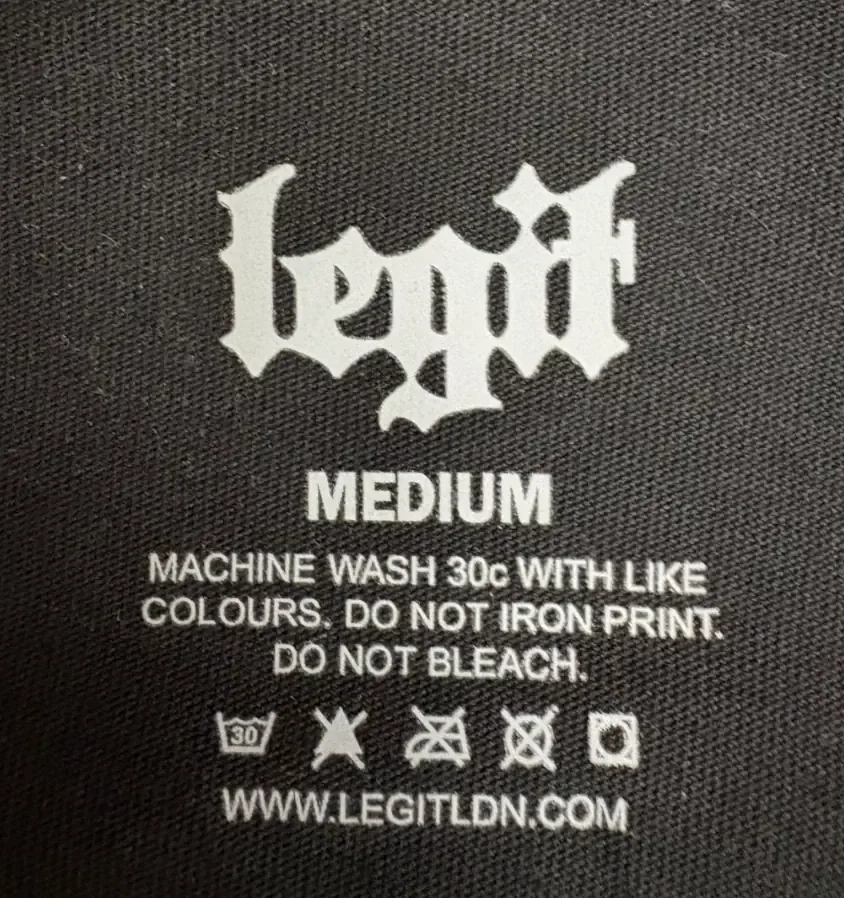
Here is an inside neck print we recently produced for a client. We neatly removed the original label and printed the client's logo, the garment size, the wash care instructions and the care symbols in the back of the neck. The fibre content did not need to be printed in the neck, as it could stay on the care label inside the side seam. This depends on the garment you choose and needs to be checked. Many brands now choose an inside neck print rather than a sewn in label, because a tagless print does not irritate the neck the way a label can, and it has become much more popular with our clients over the last few years.
Sewn in woven labels
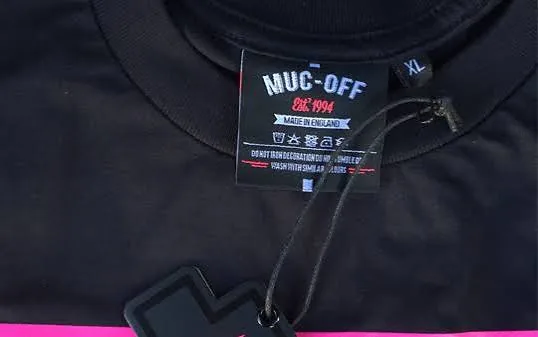
A woven label is a fabric label with your logo woven into it, sewn directly into the neck seam to replace the brand's label. It results in the traditional feel of a high street garment and can carry your brand details, wash care instructions and garment information. A separate size label can be stitched alongside it, as on the Muc-Off t-shirt at the top of this guide, which also has a swing tag.
If you are not sure which suits your range, our team can talk you through both options.
What Must Be on a Clothing Label in the UK?
When you replace a label, you should take on the information that was printed on the original label. The safest approach to relabelling is to copy everything from the label you removed onto the new one, and if you have any doubts at all, contact the manufacturer or speak to one of our team.
In Great Britain, the main legal requirement is fibre composition. The detailed rules sit in the retained EU Textile Regulation (EU) No 1007/2011, which the UK kept after Brexit, and the Textile Products (Labelling and Fibre Composition) Regulations 2012 give Trading Standards the power to enforce them. Textile products must show their fibre composition, for example 100% cotton, or 80% cotton and 20% polyester, using the standard fibre names: elastane, for instance, rather than a trade name on its own. The label must be durable, easy to read, visible, accessible, securely attached and written in English.
The fibre content is not required to be on the neck label, but it must be somewhere on the garment, and on many garments in the UK it will be found on the care label sewn inside the side seam. That means you can replace the neck label with a printed neck label or your own woven label, while the fibre content stays on the seam label. Some blanks carry all the required information on the neck label, so if the fibre content is only on the label you remove, it has to go on your new one.
Northern Ireland follows the EU textile rules directly. If you sell into the EU, the fibre composition must be given in the official language of each country where the garment is sold, and individual countries can have their own rules as well. It is important you follow the rules of the country you are selling in.
Care labels and country of origin are not legal requirements for clothing sold in the UK. Care instructions are voluntary, but a lot of customers look for them, most retailers ask for them and some export markets now require them, so we would always recommend including them. Country of origin is optional too, but if you state it, it must be true. Whatever is on your label must be accurate and never misleading. The end client is responsible for ensuring the information given is correct.
Once your own brand is on the label, UK product safety law now treats you as the producer of that garment, so it is worth keeping a record of which blank style and supplier each product uses.
What to put on your new label
- Fibre composition. A legal requirement in the UK and the EU. It must be somewhere on the garment, and is often on the care label inside the side seam.
- Care instructions (recommended). Washing and drying guidance, usually shown with care symbols. Our wash care guide explains the basics.
- Country of origin (optional). If you include it, copy it from the original label so it stays accurate.
- Size. On the label itself or on a separate size label.
- Your brand. Your logo or brand name, and your website if you like.
This is general guidance rather than legal advice. If you are unsure what your garments need, check with your local Trading Standards service or the garment manufacturer. We are always happy to pass on as much information as we possibly can to help.
Is Relabelling Clothing Legal?
Yes. Relabelling blank garments is legal and also very common, as long as your new label carries the required information and is accurate. Many wholesale brands make blanks with relabelling in mind, and some use tear-away labels to make it easier, but it is still worth checking a brand's terms before you build a range on it. If you are unsure about a particular garment, ask us and we will tell you what we know. Many brands you own or see on the high street will have been relabelled.
What is not legal is putting another company's brand name or logo on your labels, or passing off another brand's products as your own. That is trade mark infringement and passing off, and it can lead to legal action, seized stock and serious fines.
Adding Sizes to Relabelled Garments
Every garment needs its size shown. It can go on the label you design, on a size label stitched beside a sewn in label, or on a small label just above a printed neck label. Some manufacturers, such as Earth Positive (formerly Continental Clothing), include a size tab in some of their garments, which makes rebranding much easier.
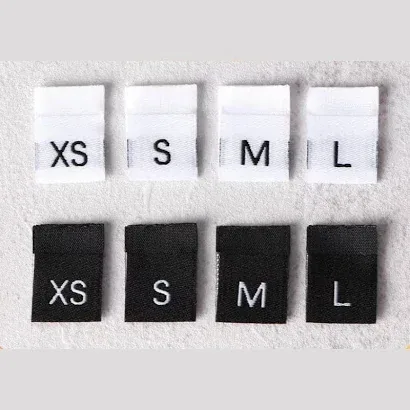
Printing the label makes sizing very easy to handle. If you order 100 small, 100 medium and 100 large t-shirts, for example, we tape over the medium and large text on the screen while we print the small garments, so those sizes are not printed. When we print the mediums, we tape over small and large, and so on through every size in your order. Alternatively, we can use a high quality transfer. The technique depends on the order size and how many of each size you need.
Hem Tags
Hem tags have long since become one of the most popular finishing touches in branded t-shirt printing. Even if you have not heard the name, you will almost certainly have seen them. A hem tag is a small label folded into the hemline of a garment, most commonly a t-shirt, and usually placed on the sleeve or at the bottom left of the front hem.
A hem tag produces a simple, clean finish and puts your brand on the outside of the garment, without needing lots of information inside the neck. Hem tags are usually small woven labels, and they suit heavier tees, sweatshirts and hoodies, where a discreet branded detail on the outside matters as much as the main print.
Swing Tags
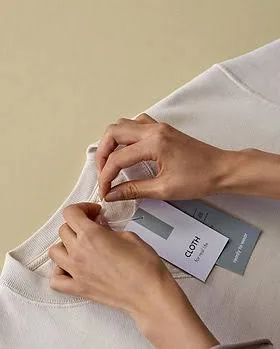
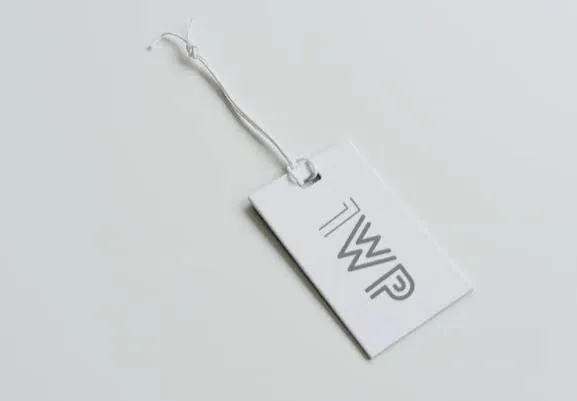
Swing tags finish a garment when it is being sold at retail. They are printed to your specification, can be made from a range of materials and are attached to each garment with a kimble. They are also the right place for details that do not belong in the neck, such as your sell price, unique barcode, website URL or the story behind your brand or the particular product.
Folding, Bagging and Barcodes
If your stock is being sent to a fulfilment house, a warehouse or straight to your customers, we can fold and bag each garment in our 90% recycled polyester bags (which can also be recycled after use), and add stickers carrying unique barcodes, SKU codes or size information. We can produce all of these for you. Your stock can then be received and picked straight away. Every option is covered on our garment finishing page.
The Best Garments for Relabelling
The easiest garments to relabel are the ones made with brands in mind.
- AS Colour. We are an official AS Colour printer, and styles such as the 5082 Heavy Faded Tee, 5171 Box Hood and 5161 Relax Hood have tear out labels.
- Alstyle. Every Alstyle garment has a tear-away label, and the brand is known for extremely consistent quality.
For more ideas, see our guides to clothing brands worth personalising and the best oversized t-shirts for screen printing.
How Relabelling Works at 1WorldPrint
- Send us your spec. Let us know your garment of choice, quantities, label style, any chosen tags and your delivery deadline. Your dedicated Account Manager will come back to you within 15 minutes with pricing and a full breakdown.
- Approve your free visual proof. We show your design at the size and position it will appear, and nothing goes into production until you are happy.
- Print, relabel and finish. We print your garments using screen printing, direct to garment, direct to film or embroidery, replace the original labels with yours, add any tags, then fold, bag and sticker if needed.
- Delivered straight to your door. Tracked delivery with reliable UK couriers, and shipping into Europe and worldwide whenever you need it.
Our standard turnaround is six to seven business days from artwork approval, and express turnaround is available on request. If you need an express order, we always recommend calling us.
Why Brands Choose 1WorldPrint for Relabelling
Why would you have your garments printed at one print house and finished at another, doubling your workload? Our job is to make your life easier. At 1WorldPrint everything is printed, relabelled and finished in one print house, with one contact and one invoice.
- Every technique in one place. Screen printing, the most popular choice with brands because we match your brand's Pantone colour, plus direct to garment, direct to film and embroidery.
- Brands that grow with us. We have seen brands grow from an idea to ordering thousands of garments a month, and 95% of the clients who print with us become return customers. That is something we are very proud of.
- A dedicated Account Manager. One point of contact from quote to delivery, and a free visual proof with every order. No more explaining your spec to several people.
- Business accounts. 30/60 day credit terms are available, subject to credit checks.
Get a relabelling quoteor call 0208 064 1315
T-Shirt Relabelling FAQs
What is t-shirt relabelling?
T-shirt relabelling is when you remove the manufacturer's original label from a blank garment and replace it with your own, either printed inside the neck or sewn in as a woven label, so the garment can be sold under your brand. It is the simplest way to start a private label clothing range.
Is it legal to relabel clothing in the UK?
Yes, it most certainly is. Relabelling blank garments is legal and widely done, as long as your new label carries the required information, is accurate and does not use another company's brand name or logo. Many wholesale brands now actively support relabelling, but check the brand's terms and conditions first, or speak to one of our team.
What must be on a clothing label in the UK?
Fibre composition is the main legal requirement, under the Textile Products (Labelling and Fibre Composition) Regulations 2012. It must be in the English language, durable, easy to read and securely attached somewhere on the garment, which is often the care label inside the side seam rather than the neck label. We would also recommend adding care instructions and the garment size.
Do clothing labels need care instructions or a country of origin?
Neither is an actual legal requirement in the UK. Care instructions are voluntary, but customers and retailers often expect them, so we always recommend including them. Country of origin is optional, but if you include it, it must be true and accurate.
Should I choose a printed neck label or a woven label?
A printed neck label is tagless, so there is nothing to scratch the neck, and the size is printed as part of the run. A woven label is sewn into the neck seam for a traditional retail feel. Both can carry your brand, size and care details, and inside neck prints have become much more popular with brands over the last few years.
Can you remove the original labels?
Yes. We neatly remove the existing label and replace it with a printed neck label or a sewn in label. Garments with tear-away labels, such as many styles in the AS Colour range, come out cleanly and take less time to relabel.
Can you add hem tags and swing tags?
Yes, we can. We can add hem tags on the sleeve or front hem, print swing tags to your specification and attach them with a kimble, then fold, bag and barcode each garment so it is ready to sell.
What is the minimum order for relabelled garments?
Relabelling follows the minimum for the print method you choose: 8 units for direct to garment, direct to film and embroidery, and 20 units per design for screen printing.
Relabelling can feel like a bit of a minefield when you first get into it, so please use this guide as a point of reference. When you are ready, get in touch and we will piece everything together for you. You can get a quote using the button below, email hello@1worldprint.co.uk or call us on 0208 064 1315.
Ready to relabel your garments?
hello@1worldprint.co.uk · 0208 064 1315
Locations
20-22 Wenlock Road
London
N1 7GU
0208 064 1315
Visits by appointment onlyManchester Address
First Floor, Swan Buildings
20 Swan Street
Manchester
M4 5JW
0161 457 6080
Visits by appointment only