
DTF vs DTG Printing: Which Is Best for Your Custom Apparel?
Published
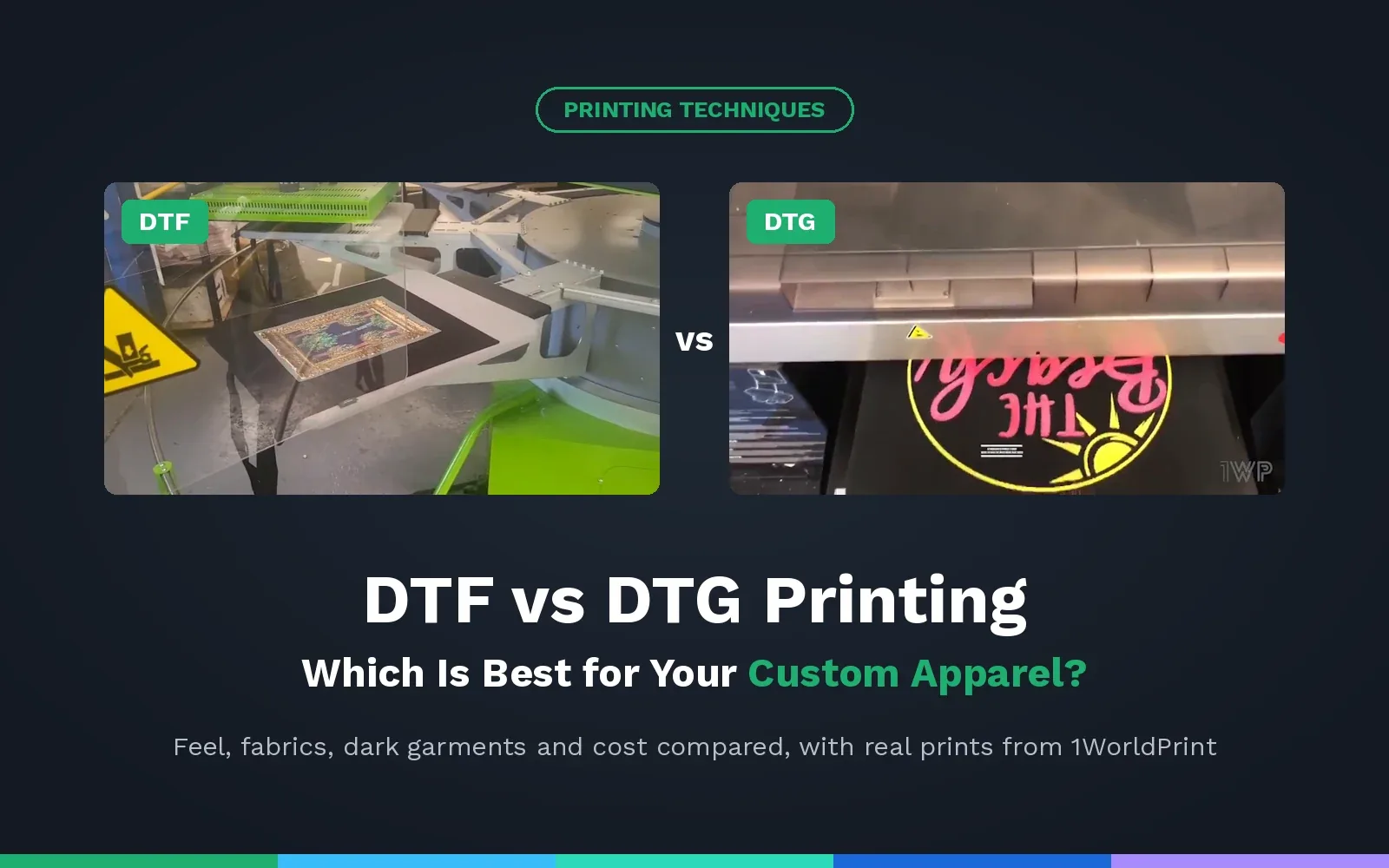
DTF or DTG? It is one of the questions we are asked most, especially for full colour designs and smaller print runs. They are both digital methods with no set up fees, but they work in very different ways. This guide compares DTF vs DTG printing side by side, with videos from our own workshop, so you can choose the right printing method for your clothing.
At 1WorldPrint we print both DTG and DTF in house, alongside screen printing and embroidery, so we have no real reason to promote one over the other. The correct choice depends on your garment, your design and your quantity, and this guide explains how to decide.
Key points
- DTG prints ink directly onto the garment, while DTF prints onto a film that is then heat pressed onto the garment.
- DTG gives the softest feel and needs garments that are at least 80% cotton.
- DTF works on cotton, polyester and blends, which makes it the go to choice for sportswear, workwear and bags.
- Both offer full colour artwork, photographs and gradients with no set up fees.
- Both start at 8 units, and for larger runs of simple designs screen printing is usually cheaper.
In this guide
- DTF vs DTG at a Glance
- What Is DTG Printing?
- What Is DTF Printing?
- The Key Differences
- When to Choose DTG
- When to Choose DTF
- Which Method Would We Use? Common Orders
- When Screen Printing or Embroidery Is Better
- Artwork Tips for DTF and DTG
- How It Works
- Frequently Asked Questions
DTF vs DTG at a Glance
Here is how the two methods compare on the points our customers ask us about most.
| DTG (direct to garment) | DTF (direct to film) | |
|---|---|---|
| How it prints | Ink printed straight onto the garment | Printed onto film, coated with adhesive powder, cured and heat pressed on |
| Best fabrics | At least 80% cotton | Cotton, polyester and blends |
| Feel | Very soft, the ink sinks into the fabric on white garments | Smooth, slightly raised finish on the surface |
| Dark garments | Pretreated, then printed with a white base | Bright and opaque, with a white layer built into the transfer |
| Detail | Excellent for photographs and soft gradients | Crisp edges, fine lines and small text |
| Set up fees | None | None |
| Minimum order | 8 units | 8 units |
| Best for | Cotton t-shirts, hoodies and tote bags with detailed artwork | Sportswear, workwear, polyester and mixed fabrics, and bags |
What Is DTG Printing?
The easiest way to explain it is that direct to garment printing works like an industrial scale inkjet printer for clothing. The garment is placed flat on the printer and the design is printed straight onto the fabric, where the ink sinks into the fibres. Because it builds the image from tiny droplets, DTG handles fine detail, photographs and smooth gradients beautifully.
On white and light garments there is no extra preparation, so the garment goes straight onto the printer and the finished print is so soft you can hardly feel it. On black and coloured garments we apply a pretreatment first and print a white base under the colours, which keeps them bright. You can see every step in our video below.
DTG requires garments that are made up of at least 80% cotton, so it is ideal for custom printed t-shirts, hoodies, sweatshirts and cotton tote bags. If you are not sure which blank to choose, our guide to the best t-shirts for printing is a good place to start.
What Is DTF Printing?
Direct to film printing puts the design onto a special film rather than onto the garment. The printed film is coated with an adhesive powder, cured, and then heat pressed onto the garment, where the design bonds to the fabric. A white layer is printed behind the colours, so DTF transfers stay bright and opaque on any colour garment.
Because the artwork is transferred rather than printed into the fibres, DTF works on cotton, polyester and blends alike. That makes it the popular choice for sportswear, performance fabrics and workwear, for personalised names and numbers on kits, and for bags and accessories. It is also the method Stanley/Stella recommends for technical jackets such as the new Stormer and Puffer 2.0, which we cover in our Stanley/Stella Autumn Winter 2026 guide.
Get a DTF or DTG quoteor call 0208 064 1315
The Key Differences Between DTF and DTG
When comparing DTF and DTG printing, the decision comes down to six things: feel, fabric, colour on dark garments, durability, detail and cost.
Feel and finish
On lighter garments DTG is the softer of the two techniques, because the ink becomes part of the fabric. DTF sits on the surface as a smooth, flexible layer. On a small chest logo you will hardly notice it, but on a large print with big solid areas a DTF transfer feels heavier and less breathable than DTG.
Fabrics
This is usually the deciding factor. DTG only works on garments that are made up of at least 80% cotton, while DTF can go onto polyester, blends and cotton. If your order includes sports tops, workwear or performance fabrics, DTF is the way to go.
Colour on dark garments
Both methods print well on black and coloured garments. DTG relies on a pretreatment and a white base layer, which can feel a little firmer than a print on a white tee. DTF always carries its own white layer, which gives very bold, opaque colour on dark fabrics.
Detail and design
Both reproduce full colour artwork, photographs and gradients really well, with no extra cost for extra colours. DTG excels at photographic images and soft fades on cotton, while DTF gives particularly crisp edges, fine lines and small text.
Durability and washing
Both methods are durable when the garment is cared for and washed correctly. DTF transfers are flexible and resist cracking, and DTG prints on good quality cotton hold up well over many washes. Washing inside out at a low temperature and avoiding ironing directly on the print makes the biggest difference, as our wash care guide explains.
Cost and quantity
Neither method has set up fees or screens, so the price per garment stays fairly steady whether you order 8 pieces or 80. That makes both suitable for samples, brand launches and short runs. For orders of 20 or more with a simple one or two colour design, screen printing usually becomes cheaper per garment, and our tips on keeping t-shirt printing costs low explain why.
When to Choose DTG
- Your garments are mainly cotton. T-shirts, hoodies, sweatshirts and cotton tote bags are perfect for DTG.
- You want the softest possible feel. Ideal for retail clothing and merch that people will wear every day.
- Your design is photographic or full of soft gradients. DTG reproduces subtle tones particularly well on cotton.
- You are ordering a short run or samples. With no set up fees, DTG is a cost effective way to test a design.
When to Choose DTF
- Your garments are polyester or mixed fabrics. Sportswear, performance tops, workwear and many jackets need DTF.
- You want strong colour on dark garments. The built in white layer keeps colours bright and opaque.
- Your design has fine lines or small text. DTF keeps edges crisp and clean.
- Your order mixes different garment types. One transfer design can be pressed onto t-shirts, polos, bags and outerwear, so the branding matches across the whole order.
Which Method Would We Use? Common Orders
These are the recommendations we give most often when customers ask us to choose between DTF and DTG.
| Order | Our usual recommendation |
|---|---|
| Band or brand merch on cotton t-shirts, under 20 pieces | DTG for the softest feel, or screen printing once you reach 20 or more of a simple design |
| Photographic or full colour design on a cotton hoodie | DTG |
| Football or running kits with individual names and numbers | DTF, because sports fabrics are usually polyester |
| Natural cotton tote bags with a detailed design | DTG, or DTF on coloured and synthetic bags |
| Staff polo shirts in a polyester or polycotton blend | Embroidery for a premium finish, or DTF for a full colour logo |
| Waterproof jackets and puffers | DTF or embroidery |
| One design across t-shirts, polos, bags and jackets | DTF, so the branding matches on every fabric |
Every person's order is different, so if your job does not fit neatly into one of these, send us the full details and we will recommend the best method and price it up for you.
When Screen Printing or Embroidery Is Better
DTF and DTG are not always the best answer. For orders of 20 or more garments with a design in a few solid colours, screen printing usually gives the lowest price per garment, with exact Pantone colour matching and very hard wearing prints. For polo shirts, workwear, caps and premium uniforms, embroidery gives a raised, long lasting finish from 8 units. You can compare every method on our printing techniques page.
Artwork Tips for DTF and DTG
- Send a PNG with a transparent background. This is the best file for both methods, especially on coloured garments.
- Work at 300 DPI at the size you want printed. Low resolution images look soft or pixelated once they are enlarged.
- Vector files are welcome too. Logos supplied as vectors stay sharp at any size.
- Avoid semi transparent effects and very faint fades. If your artwork has them, our team will check the file and suggest any changes before printing.
Every order comes with a free visual proof within 30 minutes, showing your design at the size and position it will be printed, so you can check everything before production starts.
How It Works
Four steps from first enquiry to delivered order, with one point of contact the whole way through.
Tell Us What You Need
Send over your artwork, the garments you have in mind, your quantity and your deadline, and we will recommend DTF or DTG. A dedicated Account Manager will come back to you within 15 minutes with pricing and options.
Place Order
We send a free visual proof within 30 minutes of your order being confirmed, showing your design on your chosen garments.
Printed In House
Your order is printed or embroidered, checked piece by piece and packed by our own team, with any relabelling done before it leaves us.
Delivered To Your Door
Tracked delivery using the most reliable couriers in the UK, with shipping into Europe and worldwide whenever you need it.
Frequently Asked Questions
What is the difference between DTF and DTG printing?
On white garments DTG (direct to garment) prints ink straight onto the garment, so it sinks into the fabric. On dark garments you have to put down a pretreatment. DTF (direct to film) prints the design onto a special film first, which is coated with an adhesive powder, cured and then heat pressed onto the garment. This is the same on white and dark garments. DTG gives the softest feel on cotton, while DTF works on cotton, polyester and blends.
Is DTF or DTG better for dark t-shirts?
Both print well on dark garments. For DTG we pretreat the garment and print a white base under the colours, while DTF transfers always carry their own white layer, which keeps colours very bright. If the garment is not mainly cotton, DTF is the better choice.
Can you DTG print on polyester?
No. DTG needs garments that are made up of at least 80% cotton for the ink to bond properly. For polyester, sportswear, performance fabrics and most blends, we recommend DTF printing instead.
Which feels softer, DTF or DTG?
DTG feels softer, because the ink sits in the fibres rather than on top of them. On white and light cotton garments you can barely feel the print at all. A DTF transfer sits on the surface with a smooth, slightly raised finish, which you notice more on large solid areas.
Which lasts longer, DTF or DTG?
Both are durable when the garment is looked after. DTF transfers are flexible and resist cracking, and DTG prints on good quality cotton hold up well wash after wash. The biggest difference comes from care, so wash inside out at a low temperature and avoid ironing directly on the print. Our wash care guide has the details.
Is DTF or DTG cheaper?
Neither has set up fees, so both are cost effective for short runs and designs with lots of colours. The price mainly depends on the garment, the print size and the quantity. For larger orders of a design with one or two solid colours, screen printing usually works out cheaper per garment.
What is the minimum order for DTF and DTG printing?
Our minimum order is 8 units for both DTF and DTG printing, the same as for embroidery. Screen printing starts at 20 units.
What artwork do you need for DTF or DTG?
The best file is a PNG with a transparent background at 300 DPI, especially for coloured garments. Vector files also work well. Our team checks every file and lets you know if anything needs adjusting before it is printed.
Can you print photographs with DTF and DTG?
Yes. Both are full colour digital methods, so photographs, gradients and detailed illustrations reproduce well. DTG is usually our first choice for photographic designs on cotton, and DTF is the better option on polyester or mixed fabrics.
How long do DTF and DTG orders take?
Our standard turnaround is six to seven business days from proof approval, and express turnaround is available on request. You get a free visual proof within 30 minutes of your order being confirmed.
Final Thoughts
In short, choose DTG for the softest feel on cotton and for photographic designs, and choose DTF for polyester, mixed fabrics and bold colour on dark garments. For larger runs of simple designs, screen printing is still hard to beat on price. Choosing the right printer matters as much as the method, and our guide to what to look for in a printing company covers the questions worth asking.
If you are still not sure, send us your artwork and tell us which garments you have in mind, and we will recommend the best method for the job. Email hello@1worldprint.co.uk or call us on 0208 064 1315.
Not sure whether you need DTF or DTG?
hello@1worldprint.co.uk · 0208 064 1315
Locations
20-22 Wenlock Road
London
N1 7GU
0208 064 1315
Visits by appointment onlyManchester Address
First Floor, Swan Buildings
20 Swan Street
Manchester
M4 5JW
0161 457 6080
Visits by appointment only